How to Prep Your Car the Week Before a Smog Check
September 29, 2026
Quick Answer: The week before a smog check matters more than most drivers think. Drive your car on a mix of highway and city streets for at least 15 to 20 minutes so the engine and catalytic converter reach full operating temperature before testing. Keep the check engine light off, since California's onboard diagnostic check treats an illuminated light as an automatic fail no matter how the car runs. If you recently disconnected the battery or had repair work done, plan on a week or two of regular driving so the readiness monitors can finish resetting. Check your tire pressure, change the oil if it's close to due, and make sure the gas cap seals tight, since these small items feed directly into the systems being tested.
Your registration renewal notice has been sitting on the kitchen counter for a week, and the smog appointment is booked for Saturday morning. In that same week, your car has done exactly what it always does: two miles to the gym, three miles to pick up groceries, then back into the driveway to sit. Short trips like that never let the engine or the catalytic converter reach the temperature a smog test actually measures, and that pattern alone causes more failed tests than any hidden mechanical problem under the hood.
You don't need a mechanic's toolbox to fix that. Most of what determines whether a car passes or fails happens in the days before the appointment, not during it. A little driving, a few minutes with a tire gauge, and an honest look at the dashboard warning lights can change the outcome entirely.
Start Driving It Like You Mean It
Short trips don't warm anything up
A cold engine burns fuel less efficiently, and the catalytic converter needs real heat to do its job. A good rule of thumb is at least 15 to 20 minutes of driving before your appointment, with some of that at highway speed, so the whole exhaust system reaches full operating temperature before anyone connects a scanner.
Warm it up before you go, not after you arrive
If the shop tends to run behind, plan your route so you pull in with the engine already hot rather than idling in a waiting room for half an hour first. A car that sits cold in a parking lot for twenty minutes loses the benefit of that highway drive.
Give the drive cycle room to finish
Modern vehicles run a series of internal self-checks, called readiness monitors, that confirm the emissions system is working the way it's supposed to. Those checks need steady highway speed mixed with a cold start after the car has sat overnight, spread across more than one trip. One twenty-minute drive warms the engine. A full week of normal errands is what actually finishes the monitors.
What the Check Engine Light Actually Tells the Test
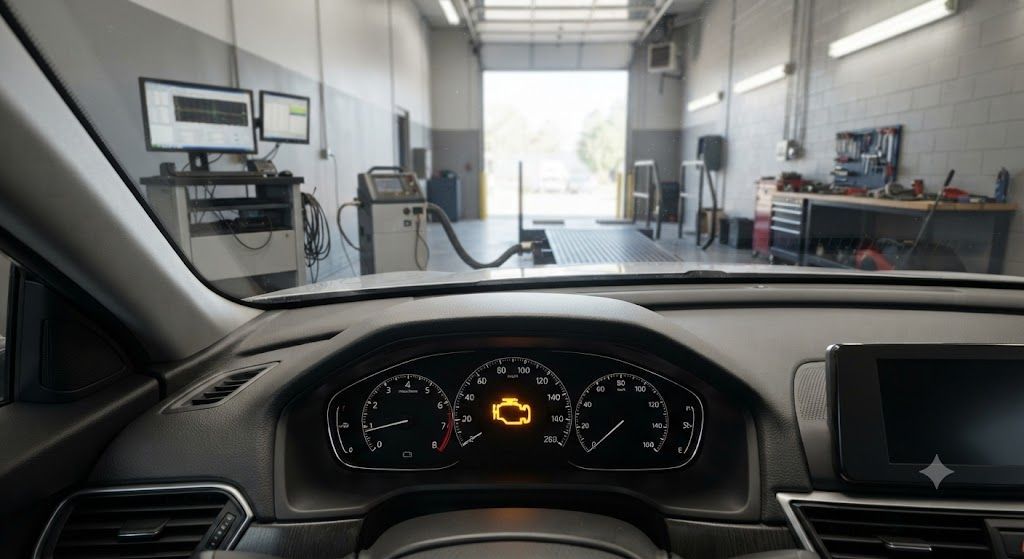
An illuminated check engine light is an automatic fail on a California smog test, full stop. It doesn't matter how smoothly the car drives, how new the tires are, or how clean the interior smells. The light means the onboard computer detected something the emissions system doesn't like, and the test simply reads that signal and reports it.
Here's the part that catches people off guard: turning off the light before your appointment doesn't erase the problem. If the light came on and then went off on its own sometime in the last few weeks, your car's computer already stored the trouble code, and a smog technician can see that history during the test. Being upfront about a recent check engine light, rather than hoping it goes unnoticed, saves you a wasted trip and a test everyone already knows will fail.
Warning: Disconnecting the battery to clear a stored code right before your appointment usually backfires. It does erase the code, but it also resets every readiness monitor to incomplete, and an incomplete monitor causes its own automatic fail. You'd trade one problem for another and lose the days of driving needed to reset the monitors properly.
The Readiness Monitor Most Drivers Have Never Heard Of
Readiness monitors are the quiet part of the test. They're internal self-checks the onboard diagnostic system runs on the emissions-related parts of your car, including the catalytic converter and the evaporative system that covers the fuel tank and gas cap. Each monitor has to report "ready" before the state's test will even evaluate it. If too many report "not ready," the car fails before a technician ever looks at a single emissions number.
California sets a specific limit on how many monitors can be incomplete and still pass. For most gasoline vehicles from model year 2000 and newer, only one monitor is allowed to still be incomplete, and it has to be the evaporative system monitor specifically. Every other monitor needs to show ready. Diesel vehicles from 1998 through 2006 get no allowance at all, and every monitor has to be complete. Newer diesels from 2007 on get a narrow exception limited to the particulate filter and the hydrocarbon monitor. These aren't arbitrary numbers. They come from the state's own Smog Check Referee Program, the office that helps drivers sort out inspection problems.
Monitors reset to "not ready" any time the battery disconnects, a trouble code gets cleared, or an emissions part gets replaced or repaired. And once that happens, the only way to bring them back is driving, not waiting. A car parked in the driveway for a week doesn't finish any monitors. A car actually driven through a mix of trips does.
Small Maintenance Items That Carry Outsized Weight
Check The Gas Cap
The evaporative emissions monitor can detect fuel vapor escaping where it shouldn't, and a loose, cracked, or missing gas cap is a common culprit. Tighten the cap until it clicks, then inspect the seal for visible wear. If it no longer holds pressure properly, replacing it before your appointment can help you avoid an easily preventable inspection failure.
Change The Oil If It's Close To Due
Old, dirty oil can break down and allow more combustion byproducts into the exhaust stream, which emissions testing measures. If your oil change is already approaching, scheduling it slightly early makes sense. Fresh oil won't fix an underlying emissions problem, but completing routine maintenance beforehand can help ensure the engine is operating properly when you take the vehicle for testing.
Check Your Tire Pressure
Underinflated tires increase rolling resistance, making the engine work harder to move the vehicle and potentially affecting emissions during testing. Check all four tires with a reliable gauge before your appointment, following the pressure listed on the driver's door label. Correcting low pressure takes only a few minutes and ensures your vehicle is operating under normal conditions when it enters the testing process.
Skip The Electrical Tape
Using electrical tape to hold together a loose hose or cracked vacuum line may seem like a quick solution, but temporary repairs can fail during the visual inspection. Technicians can identify obvious makeshift fixes, and damaged emissions-related components may result in failure. Have cracked hoses, loose connections, or other visible problems properly repaired before arriving for your smog inspection.
TIP: Bring your DMV registration renewal notice to the appointment if you have it. It tells the station whether your vehicle needs a regular test or a STAR-certified station specifically, and confirming that ahead of time saves you from showing up at the wrong kind of facility.
Leave the DIY Fixes and Aftermarket Parts Alone
If your car is running a performance tune, modified engine software, or aftermarket emissions parts, the week before a smog check is the wrong time to experiment. Modified software that hasn't been restored to the manufacturer's original calibration, or to a version the California Air Resources Board has approved, causes an automatic fail regardless of how the car actually performs. Restoring the original tune before your appointment, then reinstalling whatever custom settings you prefer afterward, is the only way around it.
Aftermarket parts carry a similar catch. Any replacement part in the emissions system, an aftermarket catalytic converter or intake for example, needs a legal Executive Order number from CARB stamped or labeled on it somewhere. An unlabeled part doesn't guarantee a failure by itself, but it forces the technician to stop and verify the part before moving forward, which turns a routine test into a longer one. If you've swapped anything under the hood in the last two years, check for that label before you go.
Frequently Asked Questions
How many days before a smog check should I start driving my car more?
A week of regular driving usually works, mixing errands with one longer highway trip. If you recently disconnected the battery or cleared a code, plan for two weeks instead.
My check engine light turned off by itself. Does that mean I'll pass?
Not necessarily. The trouble code that triggered the light usually stays stored even after it turns off, and a technician can pull that history. Have it checked first.
Can my car fail a smog check even if it drives perfectly fine?
Yes, often. The test measures specific components, like oxygen sensors and the catalytic converter, unrelated to how the car feels to drive. Smooth performance doesn't guarantee a pass.
Does changing the oil actually help me pass a smog test?
It can help, though it's not a guaranteed fix alone. Old oil lets more combustion byproducts into the exhaust, so fresh oil gives a cleaner baseline for testing.
What if I just replaced or disconnected my car's battery?
Plan on one to two weeks of regular driving. Disconnecting the battery resets readiness monitors to not ready, and only a mix of highway and city driving completes them.
Do hybrid or diesel vehicles need different prep than a regular gas car?
The basics apply to all vehicles: warm the engine and keep the check engine light off. Diesels have stricter monitor requirements, but hybrids follow the same standard diagnostic check.
What Your Prep Work Really Adds Up To
A week of intentional driving, a check engine light you didn't dismiss, and a gas cap that seals properly rarely feel like meaningful work while you're doing them. Yet these are the exact details a smog test is built to measure. Readiness monitors need real miles to finish resetting, and no amount of last-minute effort at the shop can substitute for that groundwork. By the time your appointment arrives, the outcome is often already decided, long before a technician connects a single cable.
That kind of preparation is second nature to Tri-City Smog, a STAR-certified testing station serving Temecula, California, and Menifee, CA, with 40+ years of combined experience helping drivers navigate exactly these details. Their technicians have seen every version of a car that almost passed, and they know how much a properly prepped vehicle changes the visit. Walking in ready doesn't just save time. It turns a stressful appointment into a routine stop on an otherwise ordinary day.